Industrial Flocculant: Faster Settling in Water & Wastewater
Comprehensive guide to industrial flocculants for water treatment.
What is a Flocculant?
A flocculant is a chemical used to accelerate the settling of suspended particles in water and wastewater. Unlike a deflocculant (dispersant), which disperses particles and keeps them apart, a flocculant binds fine suspended particles together into larger aggregates called flocs. Being heavier, these flocs settle faster and make it easier to separate clear water from sludge. An important point is how a flocculant differs from a coagulant: the coagulant first neutralises the electrical charge on the particles so they stop repelling one another, and the flocculant then gathers them into flocs. In many treatment trains the two are used one after the other. Choosing the right flocculant depends on the type of suspended particles, the pH and the solids load, and it is confirmed by a jar test on a real sample.
Applications and Target Industries
Flocculants have extensive applications: tile and ceramic factory wastewater treatment, industrial and municipal water treatment, mining wastewater treatment, raw material recovery from wastewater, and separation processes in various industries. In the ceramic industry, flocculants play an important role in process water recycling and reducing wastewater pollution load.
Flocculant in Industrial Wastewater Treatment
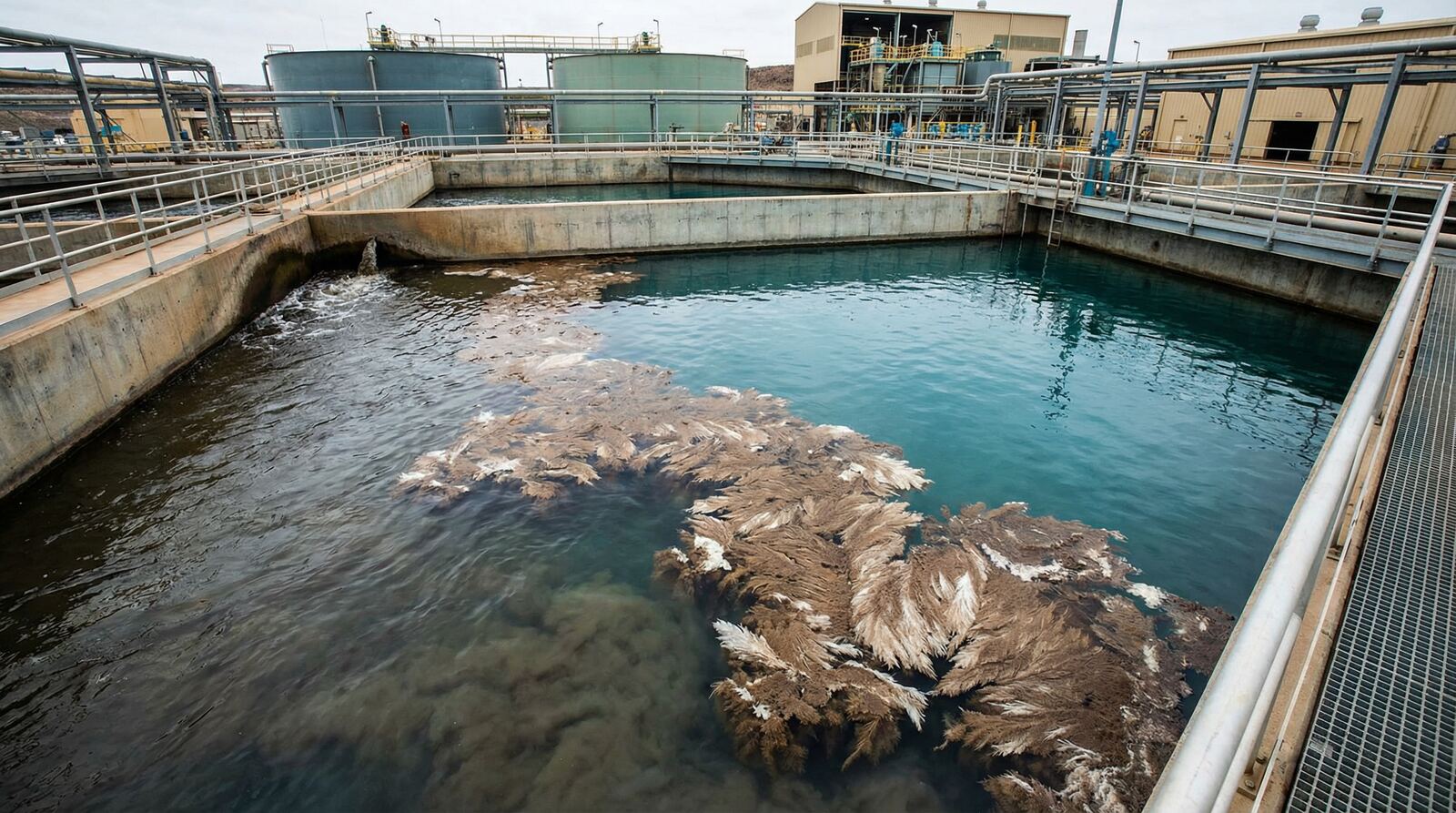
In an industrial wastewater treatment train, a flocculant is added at a specific stage, with other steps before and after it. First the raw effluent passes through screening and primary settling to remove coarse solids. Then, if needed, a coagulant is added to neutralise the charge on the fine particles. The flocculant follows, usually in a gentle mixing tank; the stirring must be enough to form flocs but not so vigorous that it breaks them. The flocs that form settle in a clarifier or thickener, the clear water overflows from the top for reuse, and the thickened sludge is drawn off the bottom for dewatering. Placing the flocculant correctly in this chain matters: adding it before the particle charge is neutralised, or over-stirring after the flocs have formed, both weaken the result.
The Jar Test: Finding the Optimal Dose
The jar test is a standard, well-known method for finding the right type and dose of flocculant, and it is done before any decision at industrial scale. Several beakers (jars) are filled with a real effluent sample, and each receives an increasing amount of flocculant. All are then stirred to a set pattern: a short rapid mix to disperse the chemical, followed by slow mixing to grow the flocs. After stirring stops, the settling speed, the size and strength of the flocs, and the clarity of the water above are compared across the jars. The smallest dose that gives the clearest water and the most suitable floc is the starting point for the working dose on the line. The jar test also shows how overdosing can have the opposite effect, re-stabilising the particles instead of settling them. Kimia Ceram Zarin runs this test on the customer's own effluent sample.
Flocculant in the Mining Industry
Flocculants play a wide role in mining and mineral processing. In tailings thickeners, a flocculant binds very fine particles so they settle faster; this frees more clear water to return to the processing circuit and reduces the volume of tailings that must be managed. In concentrate dewatering, a flocculant likewise helps separate water from solids. In processing some minerals — including circuits associated with gold extraction and metallic ores — fast, controlled settling of fine particles matters for water recovery and lower losses. As in every other application, the right type and dose of flocculant for a given tailing or concentrate is set by a jar test on a sample of that material, because the mineral makeup and particle fineness differ from one mine to the next.
Frequently Asked Questions
Which flocculant type is suitable for ceramic wastewater?
The type and dose of flocculant for ceramic wastewater are determined by a jar test on a sample of that wastewater. Ceramic wastewater usually carries fine clay and glaze particles; a suitable flocculant flocculates and settles them quickly so clear process water can be recovered for reuse. The choice depends on the particle type, the pH and the solids load.