RO Membrane Antiscalant (Kimiguard)
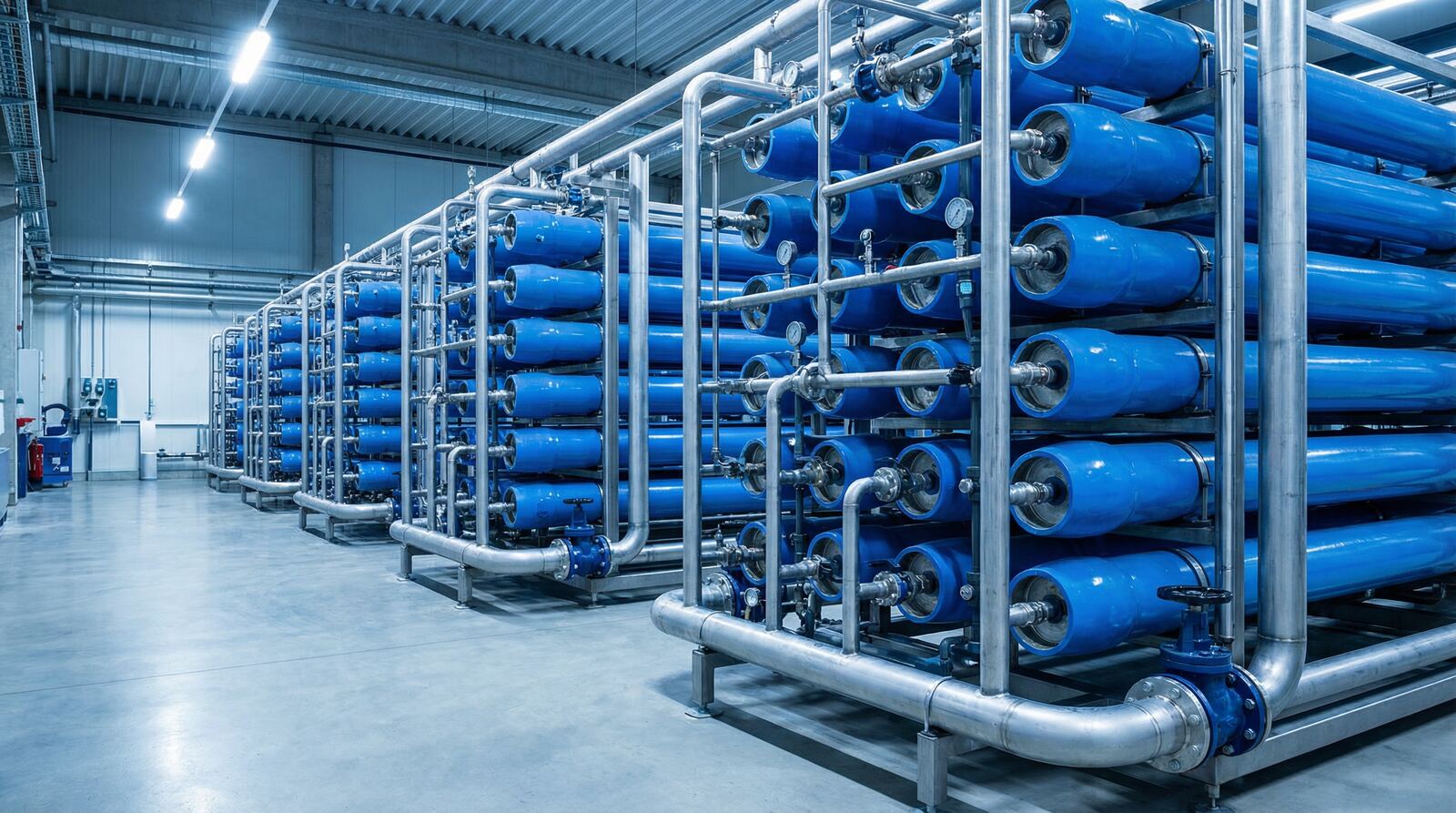
Kimiguard antiscalants are membrane antiscalants for industrial RO units, cooling towers and boilers, supplied in several grades as aqueous solutions and dosed continuously into the feed water. Selecting from the available grades and setting the dose is done by the company's laboratory, from the customer's water analysis and the unit's specifications — there is no published one-size dose. New grades are also in development. In a test by an independent laboratory using the ISIRI 19563 method (July 2025), a Kimiguard 202 sample was evaluated at a 4000 mg/L test load; scale in the antiscalant-treated sample was below 5 mg/L, with 99.8% inhibition reported for calcium sulfate and calcium carbonate. The result applies to that sample and those test conditions. Store at 15–30 °C in the original, sealed container; a safety data sheet (SDS) is supplied with every shipment.
Technical Benefits
Extended RO membrane life
Reduced membrane maintenance and replacement costs
Improved treatment system efficiency
Reduced chemical cleaning frequency
Applications
Reverse osmosis (RO) systems
Industrial water treatment
Membrane systems
Desalination plants
Cooling towers
Boilers
Industrial water and wastewater treatment
Frequently Asked Questions
Is an antiscalant right for my RO system?
That is decided by your feed-water analysis. The hardness, silica, sulphate and Langelier Saturation Index (LSI) of your water show which scale is likely and which antiscalant is needed. Send us your water analysis and Kimia Ceram Zarin will select the one that suits your RO system.
How does antiscalant reduce scaling?
Antiscalant reduces scale formation and growth on membranes through various mechanisms including crystal nuclei adsorption, crystal modification, and particle dispersion.
How often should the membrane be chemically cleaned?
The honest answer is that it depends — on the feed-water quality and the antiscalant dose. The point of an antiscalant is not to eliminate chemical cleaning but to lengthen the interval between cleanings. Heavier feed water shortens the interval; regularly monitoring the pressure differential and the permeate quality is a useful guide to when a clean is due.
How is an antiscalant different from general anti-scale products?
The difference is where they work and what they do. A membrane antiscalant is built for the pressure and high-concentration conditions of reverse-osmosis systems and reduces scale formation and growth from an early stage. A general anti-scale product is not necessarily optimised for those conditions. The right choice depends on the system type, the operating pressure and the feed-water composition.
Does Kimiguard antiscalant also control silica scale?
The independent test that was run covered calcium sulfate and calcium carbonate. Silica scaling behaviour depends on the water and is assessed from the customer's water analysis before any recommendation is made; silica scale control is not among this product's documented results.
Can it also be used for cooling towers and boilers?
Yes — both are within this product's range of application. Dosing and monitoring for cooling towers and boilers differ from RO systems and are set from that unit's own water analysis.
What does "independent test" mean? Does the result apply to my water too?
An independent test means evaluation by a third-party laboratory, under the ISIRI 19563 method, on one specific sample at one defined test load. The result belongs to that sample and those test conditions. For your water, the outcome depends on your water's own composition — which is exactly why the company asks for a water analysis. Fill in the sample-request form so that analysis can be reviewed.